
An extract from ‘Boland Bankers Behaving Badly’
Capitec’s Financial Director, André du Plessis, wasn’t one to miss an opportunity to showcase his financial wizardry. Rising impairments—the money a bank sets aside for irrecoverable loans—threatened to spoil the party. But Du Plessis wasn’t about to let pesky details like that place a cap on the rising share price and his bonus. Executive incentives, particularly the long-term Share Appreciation Rewards, were closely tied to an upward trajectory in the share price. In my opinion, when directors care more about the share price than the actual business, it’s like a chef caring more about plating than the taste of the meal. I’ve heard Gerrie Fourie exclaim numerous times that they are not concerned about the share price, but I view this as mere rhetoric. If you aren’t worried about the share price, then why are you incentivised by it going higher?
Numbers can bend the truth without necessarily breaking it. Accounting standards exist to prevent outright cheating, but they also leave room for some artful interpretations, like a jazz musician riffing on a familiar tune. When new rules are introduced, the most skilled players learn to play by them in ways that make them appear like virtuosos.
Banking is a business of perceptions, and a bank’s loan book—the sum of all the money it has lent out — acts as a report card. Investors and analysts pore over it to determine whether the bank is thriving or struggling. So, when accounting standards for loans and recoveries started to shift, Capitec’s leadership spotted a golden opportunity hidden in the so-called “grey zone”. It was an opportunity to dress up the numbers without technically crossing any lines.
At this point, Mouton and PSG Group were firmly back in the Capitec fold, and Markus Jooste still sat on PSG’s board. Did Jooste have anything to do with the accounting gymnastics? Who’s to say? But in hindsight, it’s hard not to admire the sheer audacity of the scheme — a bit like watching someone successfully pull off a disappearing act in broad daylight.
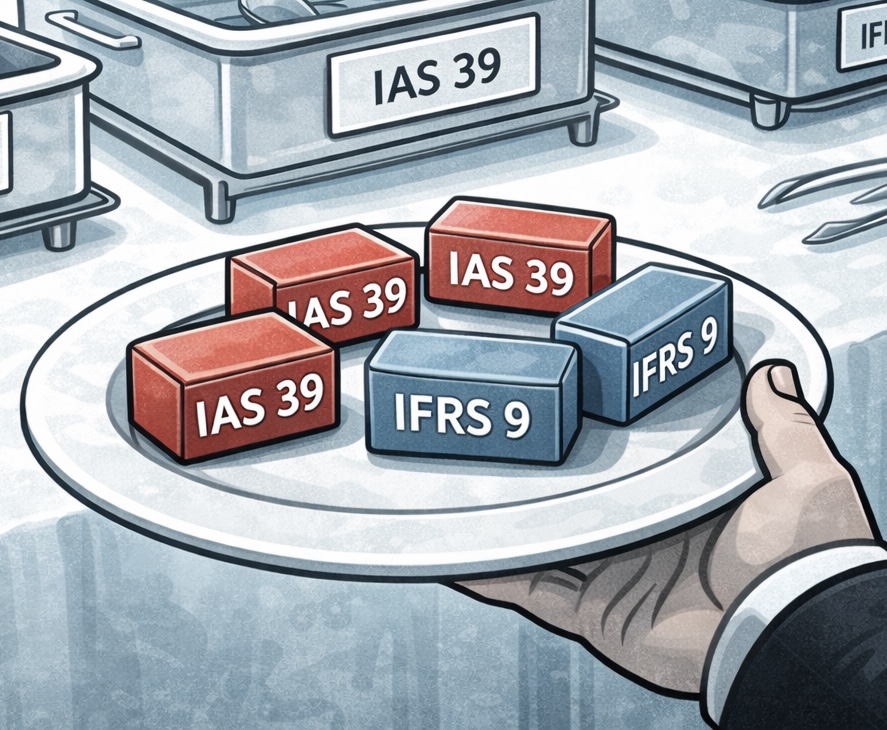
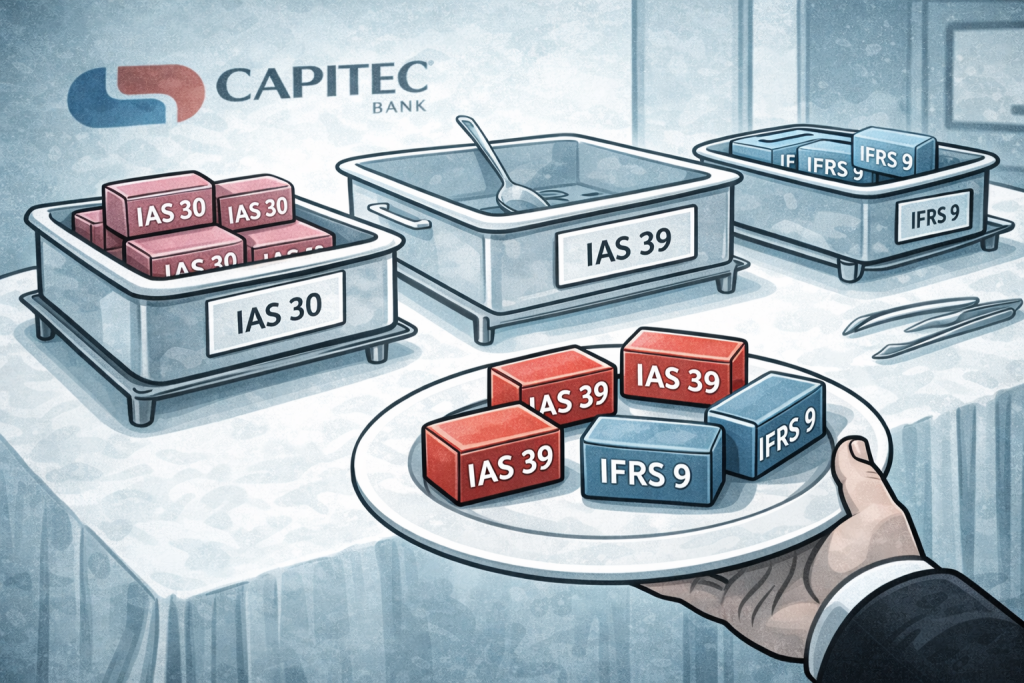
The crux of the tale lies in a technical shift from one accounting standard to another. IAS 39 would replace IAS 30 and introduce stricter rules around debt impairment and debt recoveries. Looming further down the road was IFRS 9, an even more stringent standard that Capitec cleverly continued to postpone adopting until it had no option but to adopt it in 2019. It’s not that Capitec couldn’t adapt to the new rules; it’s just that adopting them would end a little trick Du Plessis had up his sleeve. However, the auditors would need to be complicit to pull it off.
Here’s the trick: under IAS 30, Capitec wrote off any loans that were overdue for over three months. These loans vanished from the balance sheet, and any future recoveries were treated as delightful surprises — like finding a forgotten tenner in your coat pocket. However, the new accounting standards allowed for future recoveries, estimating how much might be clawed back from bad debts and reflected as a value today. You increase the gross loan balance and turnover by the estimated future recoveries. It’s a minor tweak, sure, but one with significant implications.
Du Plessis seized this opportunity like a magician pulling rabbits out of a hat. In 2009, Capitec added R11.3 million to its loan book, representing the present value of expected future recoveries. It doesn’t sound like much, but this sleight of hand boosted headline earnings by 5.4%. It was financial alchemy at its finest. Technically, there is nothing wrong with recognising recoveries before they materialise in IFRS 9. Save for the fact that you must also account for estimated future credit losses or bad debts to balance the scales. While deceptive, it wasn’t illegal, just as it wasn’t illegal for Lehman Brothers to exploit the loophole in FAS 140.
By the following year, the magic show was in full swing. Capitec doubled the trick, adding another R15.6 million in impairments to gross loans. Over a two-year period, the bank generated R38 million in “future recoveries,” impressing investors with what appeared to be higher profits and lower impairments. Du Plessis had expertly fiddled with the ratios analysts cared about most, making the numerator smaller and the denominator larger — the financial equivalent of wearing vertical stripes to appear slimmer. Capitec’s manoeuvre fell squarely into that “grey zone” where the rules were arguably open to interpretation but should have required meticulous disclosure and defensible assumptions.
Imagine if you could provide for future sales in your business — report them today, pat yourself on the back for record-breaking revenue, obtain your bonus, but hold off paying tax on those sales until they happen. A bit of accounting magic would make any entrepreneur’s eyes twinkle.
Critics might argue that Du Plessis didn’t overreach. After all, recoveries in 2009 were R46 million, climbing to R72 million in 2010 and reaching R100 million by 2011. But there’s more to that story — something we’ll dissect in a future chapter about how the multi-loan product worked and how they calculated recoveries. What’s more telling is how Capitec’s provisioning trends steadily declined, even as the loan book grew rapidly. On paper, it all looked marvellously optimistic.
Capitec’s executives had a polished narrative. They claimed their loan book quality improved thanks to better due diligence and tighter credit controls. Default rates were stabilising, and recoveries were climbing. Yet, how did the bank go from no recoveries in 2007 to R100 million by 2011?
In the world of finance, perception is reality. And while Capitec’s narrative was convincing, even the most minor cracks in that story could cast long shadows. By 2012, the fine print was starting to tell a more complicated tale that didn’t align with the bank’s straightforward, no-nonsense image. But, as with any good magician’s act, the audience often prefers the illusion to the truth.
- Capitec 2009 Annual Financial Statements pg. 20
- Capitec 2010 Annual Financial Statements pg. 95