
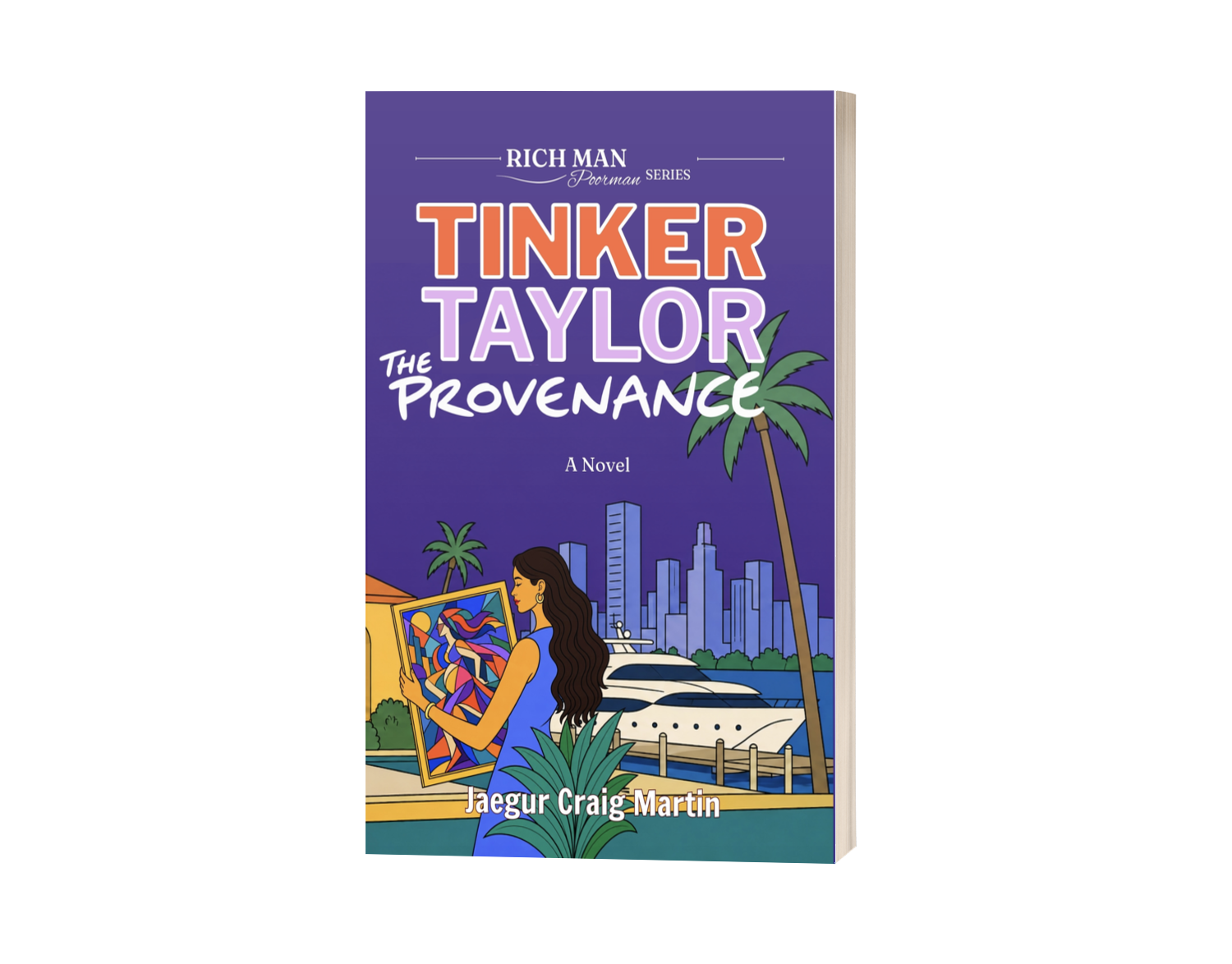
Below is an excerpt from Chapter 7 of Tinker Taylor — The Provenance, Book One of the “Rich Man Poorman” series. Mia Gonzalez, a Cuban housekeeper who fled Havana in 1989 with a stolen Picasso, has just found a gallery owner willing to examine the painting properly for the first time…
7. The Provenance
14h30 Saturday, February 10th, 1990
Gallery Méridien, Coconut Grove, Miami-Dade County
Mia had heard about the second gallery from a woman at Rosa’s church, Dolores. Rosa had invited Mia to attend the church, but she had provided reason enough for Rosa not to insist. Dolores had mentioned that one of the men at their church, a retired lawyer, collected what he called modern contemporary art. He had bought some of his collection from a dealer on Main Highway who was said to be more open-minded than most. Dolores remembered the dealer’s name and wrote it down for her.
This was the first day that Mia had had off since she had started working, and so here she was in front of Gallery Méridien.
She walked in holding the supermarket bag and an expectation that this conversation would go differently and she would be returning without the bag or its contents.
The dealer this time was a Canadian woman, around fifty, dressed simply, with reading glasses hanging to a cord around her neck. Her name was Hélène Pardieu. She had come to Miami from Montreal in the late seventies and had opened the gallery in nineteen eighty-two. She had a reputation for handling works whose paperwork was imperfect but whose quality was impeccable.
She did what the first dealer had not. The woman touched the painting. Not with the naked finger, she wore a thin white glove. She ran it lightly over the contours of the paint. She turned it over. She took it to the north-facing window and held it under the light, all the while, saying nothing. She examined the back of the canvas, the tacks, the stretcher bars, the small brown stain in the lower left corner that had been there as long as the painting had hung in the Havanen villa. She examined the signature with a jeweller’s loupe. Mia was certain that she saw her nod her head before she ran one careful finger along the edge of the paint.
When she was finished she set the painting back on her desk and removed her glasses.
“It is quite likely authentic,” she said.
Mia’s breath caught.
“I say probably only because I am not an authenticator of this period, and I would not, in any case, authenticate it on my own. Does this come with any paperwork?”
“You have my word that it is real.”
The dealer looked over the top of her spectacles, sitting half nose, as she muttered, “Your word isn’t well — worth the paper it is written on, Madam. I need documented provenance. I am curious to learn how you came to have it,” she asked, but Mia chose not to recognize it as a question.
“How did you happen upon the painting, Madam? “ she asked with more intent.
“The Patrón.”
“Madam. I am going to ask you once, and then I am not going to ask you again, and I would like you to think carefully before you answer. Did your employer give it to you, or did you take it?”
Mia was quiet. She thought that the question was rather bold to be asking of a stranger.
“I am not a policewoman,” Hélène said. “I only care about the answer, because it will determine what I am willing to do for you, if anything, and I cannot decide that without knowing.”
“My employer is not here,” Mia said.
“Yes, madam. That was implied, when you walked in alone with this painting in your shopping bag.” She rolled her tongue and made a sympathetic sound before proceeding with what was beginning to sound like a lecture. “There are perhaps forty or fifty of you in Miami at the moment, carrying perhaps a thousand objects or more, and I have seen perhaps thirty of said objects in the last six months.” Hélène’s voice did not change. “Do you have any proof that your employer gave this painting to you? Better still, do you know how he came to acquire it? “
“No.”
Hélène Pardieu looked at her, while rapidly revising her understanding of who it was who walked into her gallery. “Madam. I am going to tell you something that I usually don’t tell anyone. Firstly, no honest dealer in America can, nor should they, buy this work. What I can tell you is that I am sure that the painting is authentic, and that if you are able to prove its provenance, it will be worth the work.”
She paused to see if Mia was keeping up with her. “The painting is an asset you cannot currently realise. I am sorry. I am not being unkind. I am merely telling you the truth because I believe you deserve the truth.”
Then, the woman wrapped the painting in the dish towel herself, carefully, with a tenderness that Mia would remember afterwards. She returned it to the supermarket bag. She walked Mia to the door.
At the door she said something else.
“Madam. I want to tell you one more thing, because I think you should hear it from someone. There are dealers in this city who will buy this painting tomorrow for cash. Ten thousand dollars, perhaps. Fifteen if you negotiate well. They will not ask about provenance. But, they know that with provenance it is worth a great deal more than they will pay you. For these dealers, Madam, provenance can be manufactured. Do you understand what I am saying?”
“Yes. I think so,” Mia replied.
“I do not recommend that you sell it to any of those dealers. I do not recommend it because the men who buy paintings without provenance in 1990 in Miami are not men who are safe to transact with, and the cash they pay you is not cash that stays with you if they later decide they want it back.”
“I understand,” Mia responded.
“Good.” Hélène opened the door. “Go home, madam. Hold the painting. If you have made any progress on a paper trail, we can talk again.”
“Thank you.”
“Madam. One more thing.” Hélène’s voice dropped slightly. “Do not take that painting to the man on Calle Ocho. The one above the bodega. Whatever he tells you. He had a way of sniffing these kinds of works out. Do not even show him the painting.”
Mia looked at her.
Then phrasing it more as a statement than a question, the woman added, “You know which man I mean!”
“I do not,” Mia responded honestly.
“You will.” Hélène nodded, closed the door, and Mia was back on the Coconut Grove pavement with the supermarket bag in hand.
❧ ⁂ ❧